How Many Carbs Per Hour? A Guide by Session and Race Length
The research range for carbs per hour, from a 1 hour run to an IRONMAN: when 30 g is plenty, when 90 g pays, how to train your gut for more, and how to plan it for your race.
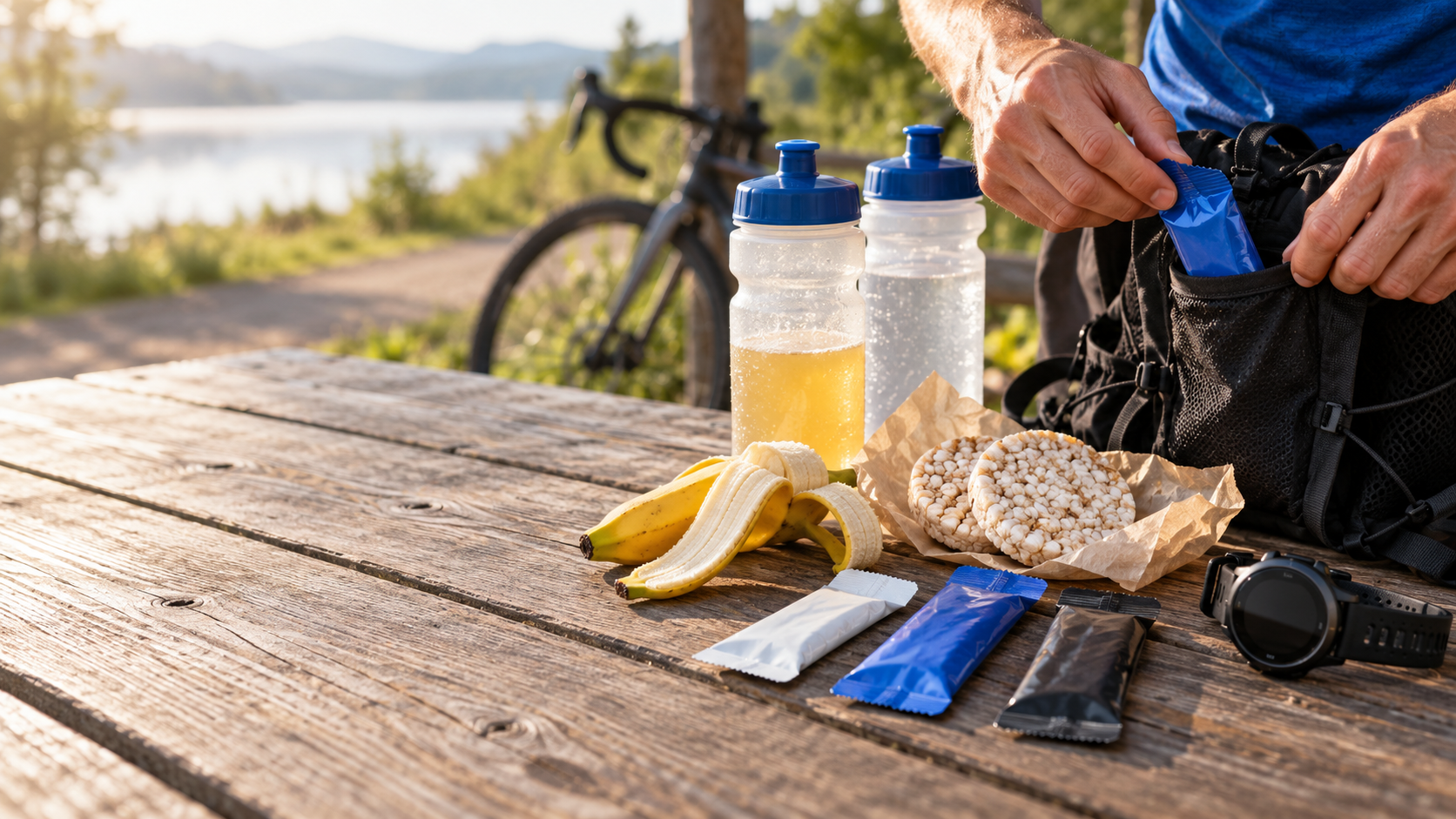
The short answer: it depends on how long you go. Under about 75 minutes you need little or nothing. From 75 minutes to 2 hours, 30 to 60 g an hour. From 2 to 3 hours, 60 to 90 g an hour as a mix of glucose and fructose. Beyond 3 hours, 60 to 90 g, and up to 120 g if you have trained your gut for it.
Those four bands come from the research below. This guide explains why each band sits where it does, what a trained gut means, and how to turn a range into a race plan. If you want your number now, the free Race Fuel Planner takes your event, finish time, heat and gut and gives you carbs, fluid and sodium per hour, with every number linked to its source.
The four bands at a glance
| Session or race length | Carbs per hour | What kind |
|---|---|---|
| Under 75 minutes | 0 to 30 g, or a mouth rinse | Any |
| 75 minutes to 2 hours | 30 to 60 g | Any single sugar is fine |
| 2 to 3 hours | 60 to 90 g | Glucose and fructose together |
| Over 3 hours | 60 to 90 g, up to 120 g if gut trained | Glucose and fructose together |
These bands follow Jeukendrup's 2014 review of carbohydrate intake during exercise (source) and the 2016 joint position statement of the American College of Sports Medicine, the Academy of Nutrition and Dietetics and Dietitians of Canada (source). They are ranges, not prescriptions: where you land inside a range depends on your size, how hard you go and how well you tolerate food on the move.
Under 75 minutes: your stores cover it
A trained athlete starts a session with enough stored glycogen for well over an hour of hard work, so for a 45 minute tempo run or a 1 hour spin, eating during the session adds little. At the top end of this band a mouth rinse can help: swish a sports drink and spit it out. Start fueled, take a drink if it is hot, and save the gels for longer days.
75 minutes to 2 hours: 30 to 60 g an hour
Here, carbohydrate taken during the session starts to matter for performance. Thirty grams is roughly one standard gel or 500 ml of a typical sports drink. Sixty grams is two gels, or a gel and a bottle.
At this length the type of sugar matters less. Your gut absorbs glucose through one transporter, and that transporter can handle about 60 g an hour on its own (Jeukendrup 2010, doi:10.1097/MCO.0b013e328339de9f). Below that ceiling, any glucose based product works.
This band covers most long training runs and rides, and it is where many athletes undereat: a 90 minute progression run on water alone feels fine until the last 20 minutes.
2 to 3 hours: 60 to 90 g, and the sugar mix starts to count
Above 60 g an hour, a single sugar hits the transporter ceiling and the extra sits in your gut. That is where bloating and cramping come from. The fix is to add fructose, which is absorbed through a different transporter. With both routes open, total absorption rises to around 90 g an hour and above.
Currell and Jeukendrup showed this in a 2008 trial: cyclists took 1.8 g a minute of either glucose alone or glucose and fructose during a 2 hour ride, and the mixed drink produced an 8% better time trial afterward (source). Many gels and drink mixes for long efforts already combine the two, often at about 2 parts glucose to 1 part fructose.
This band covers a 2:30 to 3:30 marathon, a 70.3 bike leg, a long gravel ride and most HYROX athletes on a big training day. For HYROX race day itself, which usually runs 60 to 100 minutes, the lower bands apply; the HYROX Pace Planner and the HYROX London fuel plan show what that means for your finish time.
Over 3 hours: 60 to 90 g, and up to 120 g for a trained gut
For an IRONMAN, an ultra or a long day in the mountains, the same 60 to 90 g range is the starting point. The newer question is how much higher you can go.
In 2020, Viribay and colleagues gave trained trail runners 120 g an hour during a mountain marathon and found less muscle damage markers afterward compared with 60 or 90 g (source). Podlogar and Wallis reviewed this newer work in 2022 and concluded that intakes above 90 g an hour can help some athletes, while stressing that the evidence base is still small and individual tolerance varies a lot (source).
So 120 g is a ceiling for athletes who have practiced it, not a target for everyone. If you have never taken more than 60 g an hour in training, race day is not the time to try 100.
See how this plays out on real courses: the IRONMAN Hamburg fuel plan, Challenge Roth and UTMB pages put the bands next to each course and its aid stations.
What "train your gut" means
Your gut adapts to what you ask of it. In a 2017 study, Costa and colleagues had endurance runners practice taking carbohydrate during exercise every day for two weeks. Afterward they absorbed more and reported fewer gut symptoms during a hard run (source). Jeukendrup's review of gut training describes the same idea: absorption and comfort both respond to practice over a few weeks (source).
A simple progression:
- Pick your race product and use it in training, not only on race day.
- In long sessions, start at the bottom of your band and add about 10 g an hour each week.
- Practice at race intensity at least some of the time. Your gut handles food differently at easy pace than at threshold.
- Note what goes wrong. Gut trouble during exercise is common, and de Oliveira and colleagues list high fiber, fat, protein and very concentrated drinks among the usual causes (source).
Carbs are one of three numbers
Carbohydrate gets the attention, but a race plan has two other parts.
Fluid. The National Athletic Trainers' Association position statement suggests limiting body mass loss to about 2% during exercise (source). How much that is per hour depends on your sweat rate, which can differ several times over between two athletes on the same day. Without a measured rate, drinking to thirst is a sound default. With one, you can plan. The Sweat Rate Calculator turns a before and after weigh in into ml per hour.
Sodium. For efforts beyond about 2 hours, 300 to 1,000 mg an hour is the usual range, higher in heat, with a high sweat rate or if you are a salty sweater. Baker's 2017 review explains why individual sweat sodium varies so widely (source). Drinking large amounts of plain water without sodium in long races carries a real risk of hyponatremia, as the 2015 consensus statement on exercise associated hyponatremia sets out (source).
The days before. For races over about 90 minutes, carb loading at 10 to 12 g per kg of body weight a day for the 36 to 48 hours before raises your starting stores. The Carb Loading Calculator does the math for your weight and race, and the Daily Carb Calculator covers normal training days.
Turning a range into a plan
A range becomes useful once it reads "one gel every 20 minutes and a bottle an hour":
- Find your band from the table above, using your realistic finish time, not your dream one.
- Pick your products and write down the carbs in each. A gel is usually 20 to 30 g; check yours.
- Map it to the course. Divide your hours into intervals, decide what you carry and what you take from aid stations, and practice it in a long session.
The Race Fuel Planner does steps one and three for you and prints a plan you can tape to your top tube. The Aid Station Planner maps it to a course, and the Race Day Checklist makes sure the gels are in the bag.
Where your AI comes in
A calculator gives you a good first number. Finding the number that works for you takes weeks of long sessions and notes on how your gut felt, which is what an AI assistant is good at, if it can see your training.
With Memory.fit, the AI you already use, such as ChatGPT or Claude, reads your real sessions, sleep and food, then writes a fuel plan for each long session into the Memory.fit app. It can raise your carbs week by week as your gut adapts and set fluid and sodium against a sweat test you logged. Memory.fit itself makes no recommendations: the plan is your AI's, built on your data, and you can see exactly what it wrote.
A prompt to try:
Write a fueling plan in Memory.fit for Sunday's long run: gels, when to take them, and water. Start at 60 g an hour and tell me how to build toward my race target.
Sources
All of these are listed, with every other source the site uses, on the science page.
- Jeukendrup A. A step towards personalized sports nutrition: carbohydrate intake during exercise. Sports Medicine, 2014.
- Thomas DT, Erdman KA, Burke LM. Nutrition and athletic performance, ACSM joint position statement. Medicine & Science in Sports & Exercise, 2016.
- Jeukendrup AE. Carbohydrate and exercise performance: the role of multiple transportable carbohydrates. Current Opinion in Clinical Nutrition and Metabolic Care, 2010.
- Currell K, Jeukendrup AE. Superior endurance performance with ingestion of multiple transportable carbohydrates. Medicine & Science in Sports & Exercise, 2008.
- Viribay A, et al. Effects of 120 g/h of carbohydrates intake during a mountain marathon. Nutrients, 2020.
- Podlogar T, Wallis GA. New horizons in carbohydrate research and application for endurance athletes. Sports Medicine, 2022.
- Costa RJS, et al. Gut training: the impact of two weeks repetitive gut challenge during exercise. Applied Physiology, Nutrition, and Metabolism, 2017.
- Jeukendrup AE. Training the gut for athletes. Sports Medicine, 2017.
- de Oliveira EP, Burini RC, Jeukendrup A. Gastrointestinal complaints during exercise. Sports Medicine, 2014.
- McDermott BP, et al. NATA position statement: fluid replacement for the physically active. Journal of Athletic Training, 2017.
- Baker LB. Sweating rate and sweat sodium concentration in athletes. Sports Medicine, 2017.
- Hew-Butler T, et al. Statement of the 3rd International Exercise-Associated Hyponatremia Consensus Development Conference. Clinical Journal of Sport Medicine, 2015.
Not medical advice. If you have a medical condition, talk to a doctor or a sports dietitian before changing how you eat.